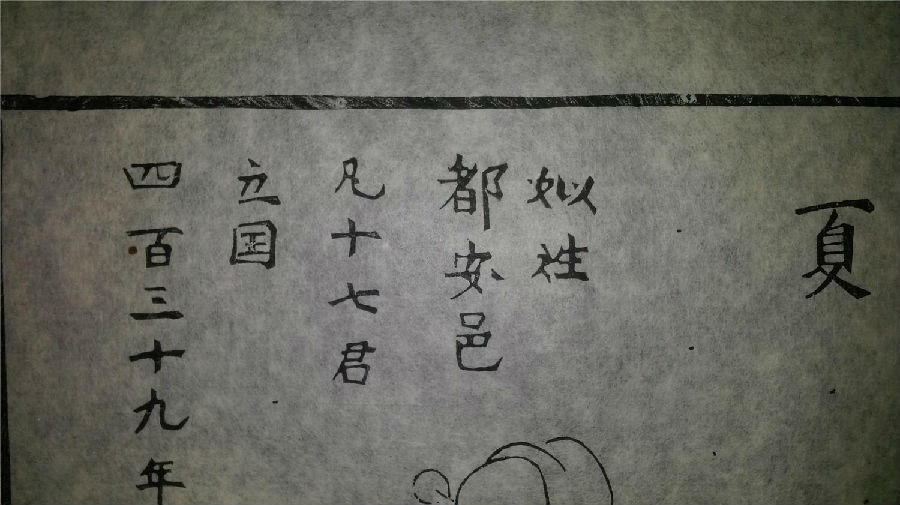
夏朝
Xia Dynasty
原始记载
Archaeological Records
与之后的商朝不同,没有直接的考古学证据存在来证明夏朝的存在。
Unlike the later Shang dynasty, no direct archeological evidence exists to confirm the existence of a Xia dynasty.
考古学家们开掘出了位于与古代中国历史文章中提到的相同位置的城区、青铜器以及墓穴,而这些都表明了夏王朝的存在。
Archaeologists have uncovered urban sites, bronze implements, and tombs that point to the possible existence of the Xia dynasty at locations cited in ancient Chinese historical texts.
大部分中国的考古学家把二里头文化视为夏朝的遗址,
Most Chinese archaeologists identify the Erlitou culture as the site of the Xia dynasty,
而大多数西方考古学家对于二里头文化和夏朝之间的联系仍不确定。
while most Western archaeologists remain unconvinced of the connection between the Erlitou culture and the Xia Dynasty.
1959年,偃师市的一个遗址被开掘,其中包含了大型的宫殿,中国的考古学家认为这是夏朝的都城,
In 1959, a site located in the city of Yanshi was excavated containing large palaces that some Chinese archaeologists have attributed as capital of the Xia Dynasty,
而西方的考古学家对于这个论断很犹豫因为没有书面的记录存在来表明这个朝代的名称和它的君主。
though Western archaeologists are reluctant to make this claim on the grounds that no written records exist to confirm the name of the dynasty and its sovereigns.
放射性炭测定此遗址的年代在公元前2100年至1800年之间,这为一个与夏朝处于同年代的甚至于就是中国历史著作中提到的夏朝的存在提供了物证。
Radiocarbon dating places the site at about 2100 to 1800 BC, providing physical evidence of the existence of a state contemporaneous with and possibly equivalent to the Xia Dynasty as described in Chinese historical works.
至少,考古学的发现标志着一个处于新石器文化末期与商朝典型的中国城市文明之间进化的阶段。
At a minimum, the archeological discoveries marked an evolutionary stage between the late Neolithic cultures and the typical Chinese urban civilization of the Shang dynasty.
伴随着红酒制造的发明,牧马的进步以及四轮马车的运用,农业技术飞速发展。
Agricultural technology improved drastically with the invention of wine making and improvements in horse herding, and carriages were used.