隋朝的衰亡
Decline of Sui Dynasty
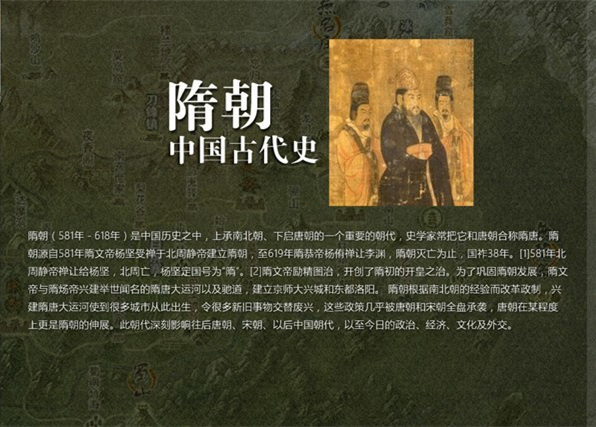
隋朝的迅速覆灭是由政府的暴虐和不断的战争所导致的。
The Sui Dynasty’s early demise was attributed to the government’s tyranny and ceaseless wars.
隋文帝于604年意外身亡,他的二儿子,也就是历史上的“隋炀帝”,继承了帝位。
Emperor Wen died unexpectedly in 604 and his second son Yang Guang, historically known as Emperor Yang, succeeded to the throne.
在隋炀帝执政初期,得益于他父亲的改革,隋朝获得了经济上的全面繁荣。
In the early part of his reign Emperor Yang benefited from the reforms introduced by his father and the Sui Dynasty achieved full economic prosperity.
然而,因为满足于自己的成功,隋炀帝很快开始滥用他的权力。
However, lulled by his easy success, Emperor Yang soon began to abuse his power.
一方面,他继续建造奢华的建筑如长城、大运河以及都城洛阳的重新布置;
On the one hand, he continued to carry out lavish construction projects, such as the Great Wall, the Great Canal and the relocation of his capital in Luoyang.
另一方面,他不断进行外出巡游并经常对邻国发动战争。
On the other, he repeatedly went on pleasure trips and all too frequently launched wars on his neighbors.
隋炀帝的一些政策确实为社会的发展与国家的稳定做出了贡献;
Some of Emperor Yang’s policy did contribute a lot to the social development and the stability of the country;
但是,这些政策让普通百姓穷困潦倒。
however, they made the ordinary people “all out at the elbows”.
隋炀帝的奢侈与堕落最终耗尽了国家的资源。
Emperor Yang’s extravagance and putridness finally led to the exhaustion of the country’s resources.
自613年开始,叛乱一场接一场爆发。
Beginning in 613, rebellions broke out one by one.
616年,迫于混乱的局势,隋炀帝撤回江都(今江苏省扬州)。
In 616, forced by the chaotic situation, Emperor Yang, retreated to Jiangdu (present Yangzhou City in Jiangsu Province).
由于皇帝不在位,镇守太原的将军李渊,控制了长安,拥立新帝登基。
With the emperor absent, Li Yuan, a general stationed in Taiyuan, conquered Chang’an and put a new emperor on the throne.
618年,隋炀帝在江都被他的臣子杀害。
In 618, Emperor Yang was murdered in Jiangdu by one of his aides.
很快,李渊废黜了新帝并在长安建立了自己的政权——唐朝并自立为帝。
Quickly, Li Yuan deposed the new emperor and established his own dynasty in Chang’an— the Tang Dynasty, declaring himself Emperor.